
Discoverability on the digital plane has seen more change in the past three years than it has seen in the past decade. By 2026, companies are no longer just vying for their position on Google—now they must also compete for discoverability within artificial intelligence tools such as ChatGPT, voice assistants, and answering engines.
For Digital marketing professionals, the key question to be asking has shifted from “How do I get ranked on Google?” to “Where are my customers really looking for me?”
The answer is not one or the other. It is both. But the balance of power is shifting, and understanding this shift is critical for business growth.
1. The Traditional Powerhouse: Google Search
For more than 2 decades, Google has been the main gateway to the internet. Billions of searches happen daily, and businesses rely heavily on SEO to capture traffic.
How Google Search works in 2026
Google still follows its core model:
- Crawling websites
- Indexing content
- Ranking pages based on relevance, authority, and user experience
But it has evolved significantly:
- AI-generated summaries (Search Generative Experience)
- More zero-click searches
- Personalized results based on user behavior
- Strong integration of video, local, and shopping results
Strengths of Google Search
- Massive global reach
- High purchase intent traffic
- Strong for local businesses and e-commerce
- Trusted for comparison-based searches
Limitations
- Increasing zero-click searches reduce website traffic
- High competition for top rankings
- SEO requires time and continuous effort
- Users often scroll less and rely on instant answers
2. The Rise of AI Search: ChatGPT and Answer Engines
On the other side, tools like OpenAI’s ChatGPT have transformed how users find information.
Instead of searching keywords, users now ask full questions like:
- “What’s the best digital marketing strategy for small businesses in 2026?”
- “Compare online MBA programs in India”
- “Which product should I choose under ₹5000?”
Why AI search is growing fast
AI tools offer:
- Instant summarized answers
- No need to click multiple links
- Personalized explanations
- Conversation-based refinement
- Decision support instead of just information
This shift is important: users are no longer just searching—they are asking and deciding.
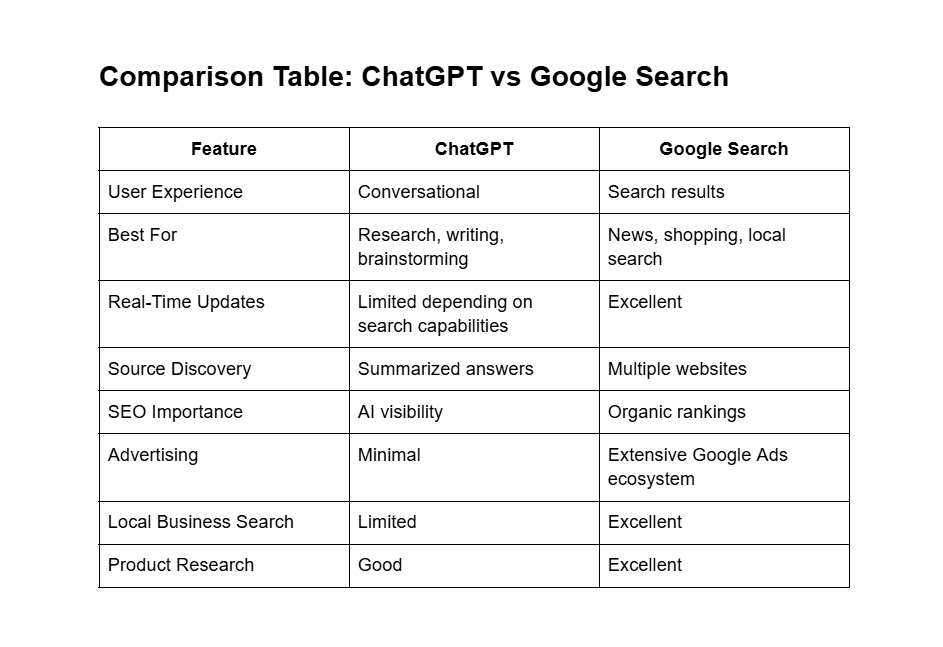
Which Platform is Better for SEO?
This is one of the most commonly asked questions by Business Owners
The solution is easy: Both are needed.
Google is still the main source of organic traffic for websites. However, AI-powered searches are now also becoming another way of discovery.
According to recent studies, AI-powered searches are continuing to rise rapidly while Google is still holding its dominant position. AI does not replace Google; it changes user behavior before coming to websites.
To succeed in modern SEO, Digital marketers should:
- Create helpful, authoritative content.
- Answer user questions directly.
- Build topical authority.
- Improve page speed.
- Add structured data.
- Keep information updated.
- Demonstrate expertise and trustworthiness.
These best practices improve visibility in both traditional google search engines pages as well as AI-powered search experiences.
Final Thoughts
The path to brand discovery is not confined to one ecosystem anymore. ChatGPT-like AI systems along with Google Search will both become equally important in the process but for different reasons.
Google Search will still be the leading channel for intent-based discovery, where users search for products, compare options, read reviews, and find solutions close by. The channel remains a great tool for capturing highly-intent traffic via SEO, ads, and featured snippets.
ChatGPT and its competitors will change the rules for decision-making and recommendations. People will use AI to:
- receive personalized product recommendations,
- compare products without visiting numerous sites,
- study and make decisions,
- solve problems via chat conversations.
Key takeaway
- Google = demand capture (search for the thing people already want)
- ChatGPT = demand shaping (help people make their decisions)
What this means for businesses
Brands have to fit into both worlds to compete:
- Build solid SEO strategy for staying visible on Google,
- Make sure your content is AI-readable and citable (structured, authoritative),
- Make your brand's content credible and worth being cited,
- Create valuable content that actually answers customer questions.
Final point
In 2026, the question is no longer "ChatGPT or Google?"
It's "How do we show up in both when customers are ready to make decisions?"
Businesses who can be found both in Google and AI assistants will get the largest share of tomorrow's clients.