
Running a small business in 2026 requires you to compete against businesses which face three main challenges: keeping up with changing customer preferences, adapting to evolving digital platforms and competing with new competitors that can reach your market with greater speed. Offering good products or services is no longer enough. Businesses must deliver additional value and give customers a clear reason to choose them over other available options.
This is where competitive advantage for small businesses becomes important. The strategy enables businesses to create distinctive characteristics which attract suitable customers while building customer loyalty that leads to long-term business growth through methods which do not depend on price reductions or increased marketing expenses.
Small businesses can achieve business success by using their existing resources without needing to match the financial strength which big corporations possess. The company will achieve industry leadership through its effective value proposition and customer-oriented methods and proper digital marketing approaches.
This blog will show you effective approaches to develop competitive advantages which will help your small business succeed during 2026.
What Is a Competitive Advantage?
A competitive advantage is a unique strength, capability, or business strategy that enables a company to perform better than its competitors in ways that matter to customers.
The business gains a competitive edge through its ability to provide excellent customer support, specialized expertise, high quality product, custom-tailored services, quick shipping, and successful promotional efforts.
For example, a local bakery competes against big bakery chains through its fresh bakery items, ability to create special cakes and its friendly customer care. The small digital marketing agency establishes its market position through its ability to develop customized marketing plans, transparent reporting and direct client interaction approach.
The main goal is to find the core strengths while you must explain these advantages to your intended customers.
1. Define Your Unique Value Proposition
Your unique value proposition (UVP) explains why customers should choose your business instead of a competitor. It highlights the specific benefits you offer and the problems you solve.
Without a clear value proposition, your business may struggle to stand out, even if your products or services are excellent.
To develop an effective UVP:
- Identify the main problems your customers want to solve.
- Research about every competitor which operates in your market sector.
- Highlight the most important elements which make you different.
- Show the advantages which customers obtain when they select your business.
- Communicate your value in simple, customer-focused language.
For example, instead of describing your business as a company that provides digital marketing services, your business should present itself as a lead generation expert which helps small businesses attract qualified prospects through SEO, paid performance marketing and website optimization methods.
Your value proposition needs to show the exact worth which people should believe and which matches their needs. Avoid making broad claims such as “best quality” or “number one service” unless you can substantiate them.
2. Understand Your Target Audience
A business needs customer knowledge to achieve any meaningful competitive advantage in the market. The various audience groups show distinct requirements when they buy products while they maintain individual expectations and specific worries.
Customer research activities help businesses find the most important elements which their target market members seek to obtain.
Start by analysing:
- Customer demographics and business characteristics.
- Common customer problems and buying motivations.
- Frequently asked questions before purchasing.
- Customer feedback, reviews, and complaints.
- Factors that influence purchasing decisions.
- Reasons customers choose competitors.
For example, customers of Direct-to-Consumer brands seem to base their buying decisions on product quality and they want to know when their orders will arrive and they need simple return procedures and they seek authentic customer feedback.
You need to use these findings to develop better products and services while enhancing your communication methods and customer service experiences. You will find it simpler to establish your market presence when your business solves the most vital consumer problems.
3. Build a Strong Digital Presence
In 2026, customers conduct online business research before they decide to purchase their desired products. Potential customers will trust your business enough to reach out when they find your business through website search results, social media profiles, online reviews and your website presence.
Small businesses achieve their target audience reach through strong digital presence which enables them to build credibility while competing with businesses outside their local region.
Focus on the following areas:
Website optimization: Create a professional, mobile-friendly website with clear service information, easy navigation, fast-loading pages, and visible calls to action.
Search engine optimization (SEO): Optimize your website to appear for relevant searches related to your products, services, and location.
Google Business Profile: For eligible local businesses, maintain accurate business information, opening hours, contact details, service descriptions, and genuine customer reviews.
Social media marketing: Share useful content, demonstrate your expertise, answer customer questions, and communicate your brand personality.
Online reputation management: Monitor customer feedback and respond professionally to both positive and negative reviews.
For example, a small accounting firm can attract potential clients by publishing helpful tax-related articles, optimizing its website for relevant local searches, and maintaining an accurate Google Business Profile.
A consistent online presence makes it easier for customers to discover your business and understand why they should consider it.
4. Use SEO to Attract the Right Customers
Search engine optimization serves as a fundamental business approach which small enterprises utilize to obtain permanent online market presence and their target customers.
Instead of depending exclusively on paid advertisements,your website will show up in organic search engine results through SEO when users search for information, products or services which match your business offerings
An effective small business SEO strategy includes:
- Keyword research based on customer search intent.
- Optimizing page titles together with meta descriptions, headings, and website content.
- Creating helpful blog posts which provide answers to customer inquiries.
- Enhancing website speed with mobile-friendly design and improved technical system performance
- Building internal connections which link pages that contain similar content.
- Earning quality backlinks from relevant and trustworthy websites.
- Local search visibility needs to reach its highest potential for areas which demonstrate relevant characteristics
For example, a small website development company could create service pages which focus on particular search phrases like "website development services for small businesses." and should also publish articles which explain website pricing structures and core website elements and typical errors in website design.
People who want to learn about website development will find these resources useful.
However, SEO takes time and ongoing effort. Results depend on competition, website quality, content relevance, and other factors. Businesses need to track their progress through specific rankings and organic website visitors who become qualified leads and complete their sales process instead of focusing on rankings alone.
5. Differentiate Your Brand Through Customer Experience
Customers who face multiple business options in their market can establish customer experience as their strongest competitive advantage.
A business organization which streamlines customer purchasing experiences and provides immediate responses with clear communication and effective problem resolution will develop customer trust that leads to customer retention.
Consider improving the following touchpoints:
- Make enquiries and bookings less complex.
- Answer customer questions right away when they receive them.
- Provide transparent pricing and service information.
- Needs to establish reasonable delivery and outcome expectations
- Offer personalized recommendations where appropriate.
- Handle all customer complaints professionally.
- Follow up after purchases or completed services.
For example, a small online retailer can create its own identity through precise product details, unambiguous shipping notifications, quick customer assistance and simple return procedures.
A service-based business needs to explain each project stage to customers while delivering continuous progress updates and showing them where their money goes.
Remember that customer experience does not end when a sale is completed. Post-purchase support and ongoing communication can influence customer satisfaction, retention, and referrals.
6. Use Data and AI to Make Smarter Decisions
Technology can help small businesses to enhance their operational efficiency while they learn about their customers and develop superior marketing approaches.
In 2026, Businesses can access analytics platforms together with AI tools which they should select properly to perform their research activities, generate reports, maintain customer contact and handle routine work starting
The system supports various operational functions which include:
- Analysing website traffic and conversion data.
- Identifying common customer questions.
- Generating initial content ideas and outlines.
- Automating routine email follow-ups.
- Segmenting audiences based on relevant customer behaviour.
- Identifying underperforming marketing campaigns.
- Supporting customer service with appropriate automation.
For example, a small e-commerce business uses website analytics to discover which product pages attract visitors but fail to convert them into buyers. The business needs to check all product details and pricing information together with website navigation elements and also checkout process problems.
AI should support human judgement rather than replace it. Review AI-generated content for accuracy, originality, brand consistency, and usefulness before publishing it. Organizations need to protect customer data while they operate their systems through proper tool application.
Businesses obtain their competitive advantage through their ability to pick suitable tools which they use to resolve actual operational challenges.
7. Develop a Smart Digital Marketing Strategy
Small businesses can enhance their market position through the combination of different digital marketing services which they select based on their business objectives and customer segments.
- SEO services: Improve organic visibility and attract customers actively searching for your products or services.
- PPC and performance marketing: Reach high-intent audiences through paid advertising campaigns and measure their results.
- Social media management: Build brand recognition, engage potential customers, and maintain consistent communication.
- Website development: Create a professional, mobile-friendly website that supports lead generation and customer conversions.
- 360 digital marketing: Coordinate SEO, paid advertising, social media, and other digital channels within a unified strategy.
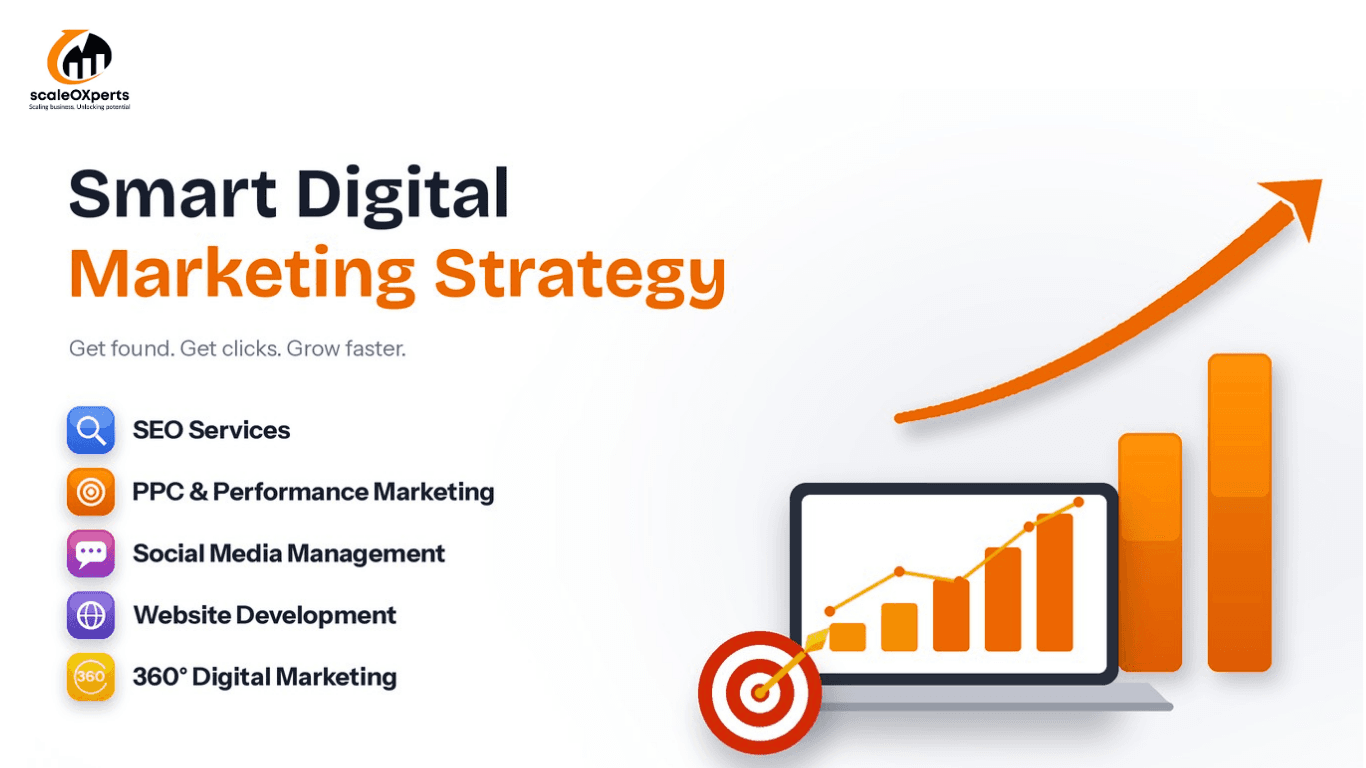
For example, a small B2B company can use SEO to attract organic traffic while running PPC campaigns to get instant leads, social media platforms to show their expertise and a website to convert visitors into leads.
Explore ScaleOXperts' SEO services, PPC and paid advertising services, social media management, and website development services to understand how these services can support your business growth.
8. Monitor Competitors and Adapt to Market Changes
Creating a competitive advantage is an ongoing process. Customer expectations, competitor offerings, technology, and industry conditions can change over time.
Regular competitor analysis helps you understand how your business compares with alternatives and identify opportunities to improve.
Review competitors':
- Product and service offerings.
- Pricing and promotional strategies.
- Website experience and messaging.
- Search visibility and content topics.
- Customer reviews and recurring complaints.
- Social media communication.
- Customer support and buying process.
Do not copy competitors simply because they appear successful. Instead, look for customer needs that are not being addressed effectively.
For example, if customers frequently complain that competitors provide unclear pricing or slow responses, your business could differentiate itself through transparent packages and faster communication.
Review your competitive position periodically and use customer feedback, performance data, and market research to decide what needs to change.
Conclusion
Creating a competitive advantage for your small business in 2026 requires more than competitive pricing or frequent promotional campaigns. It involves understanding your customers, communicating a clear value proposition, delivering a better experience, and building a digital presence that supports business growth.
You need to find the unique elements which set your business apart from others. Build your website and SEO strength through content creation which helps you make data-driven choices and you should dedicate resources to marketing platforms that produce substantial outcomes. The process of listening to customers should continue because their needs will keep evolving.
Small businesses do not need to outperform every competitor in every area. The organization must develop its position as the ideal option which targets specific customer segments.
Ready to strengthen your online presence and stand out from your competitors? Book a Free Growth Audit with ScaleOXperts. Discover how a focused digital marketing strategy can help your business improve visibility, attract qualified leads, and build sustainable growth.
Explore ScaleOXperts' digital marketing services to take the next step toward building your competitive advantage.
Frequently Asked Questions (FAQs)
1. What is the best competitive advantage for a small business?
The best competitive advantage depends on your industry and target customers. A business can develop its competitive edge through specialized expertise, excellent customer service, product quality, convenience, personalization, or a distinctive brand experience.
2. How can small businesses compete with larger companies in 2026?
Small businesses can compete by focusing on their dedicated customer base, delivering customized experiences, developing expertise and their digital marketing strategies which target particular customer groups.
3. How does digital marketing create a competitive advantage?
Digital marketing enables businesses to enhance their online presence while they access specific customer segments, deliver their value proposition, create customer leads and track their marketing campaign results. Businesses can use these research results to create better marketing choices through their data analysis.
4. Does SEO help small businesses compete with larger brands?
Yes. SEO can help small businesses gain better online visibility for relevant local searches. Success depends on search intent, competition, website quality, content usefulness, and consistent optimization.
5. How often should a small business review its competitive strategy?
You need to evaluate your strategy at least quarterly or during any time when you observe major shifts in customer responses, competitor activity, marketing performance, or market conditions. The findings need to be used for creating changes which will improve the existing system.