
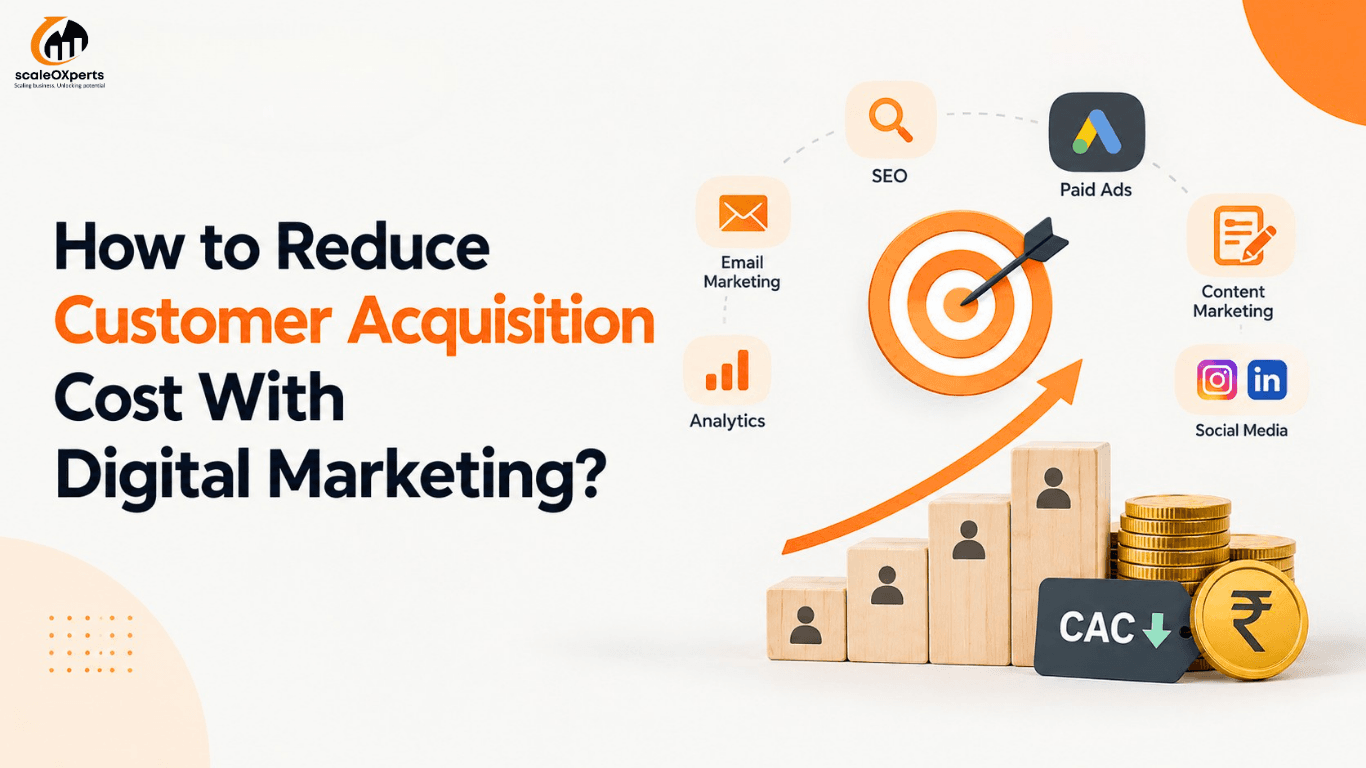
Acquiring new customers is essential for business growth, but doing so without overspending can be challenging.
Businesses invest in advertising, social media, SEO, email campaigns, and other digital marketing activities to bring potential customers to their websites. When these efforts fail to generate enough qualified leads or sales, the cost of acquiring each customer increases---and profitability can suffer.
This is where a well-planned digital marketing strategy can make a difference.
The objective is not always to spend less. It is to spend smarter by reaching the right audience, improving conversion rates, and investing in channels that generate profitable customers. From search engine optimization (SEO) to performance marketing and conversion rate optimization (CRO), businesses have several ways to improve marketing efficiency.
Before exploring these strategies, let's understand customer acquisition cost and why it matters.
What Is Customer Acquisition Cost (CAC)?
Customer acquisition cost (CAC) is the total cost a business incurs to acquire one new customer. Depending on the business and how it tracks performance, this can include marketing spend, advertising costs, sales salaries, agency fees, campaign tools, and other acquisition-related expenses.
For example, if a company spends ₹50,000 on marketing and sales activities in one month and acquires 100 new customers, its CAC is ₹500 per customer.
Formula to calculate CAC:
Customer Acquisition Cost = Total Customer Acquisition Expenses ÷ Number of New Customers Acquired
A lower CAC can indicate more efficient customer acquisition, but reducing costs should not come at the expense of customer quality, retention, or long-term revenue. Businesses should assess CAC alongside metrics such as customer lifetime value (CLV), profit margin, and lead-to-customer conversion rate.
Tracking CAC regularly helps businesses identify which digital marketing channels contribute to actual customers and where their budgets could work harder.
Why Is Reducing Customer Acquisition Cost Important?
Customer acquisition expenses directly affect profitability and the ability to scale. When businesses spend too much to acquire customers, growth can become difficult to sustain.
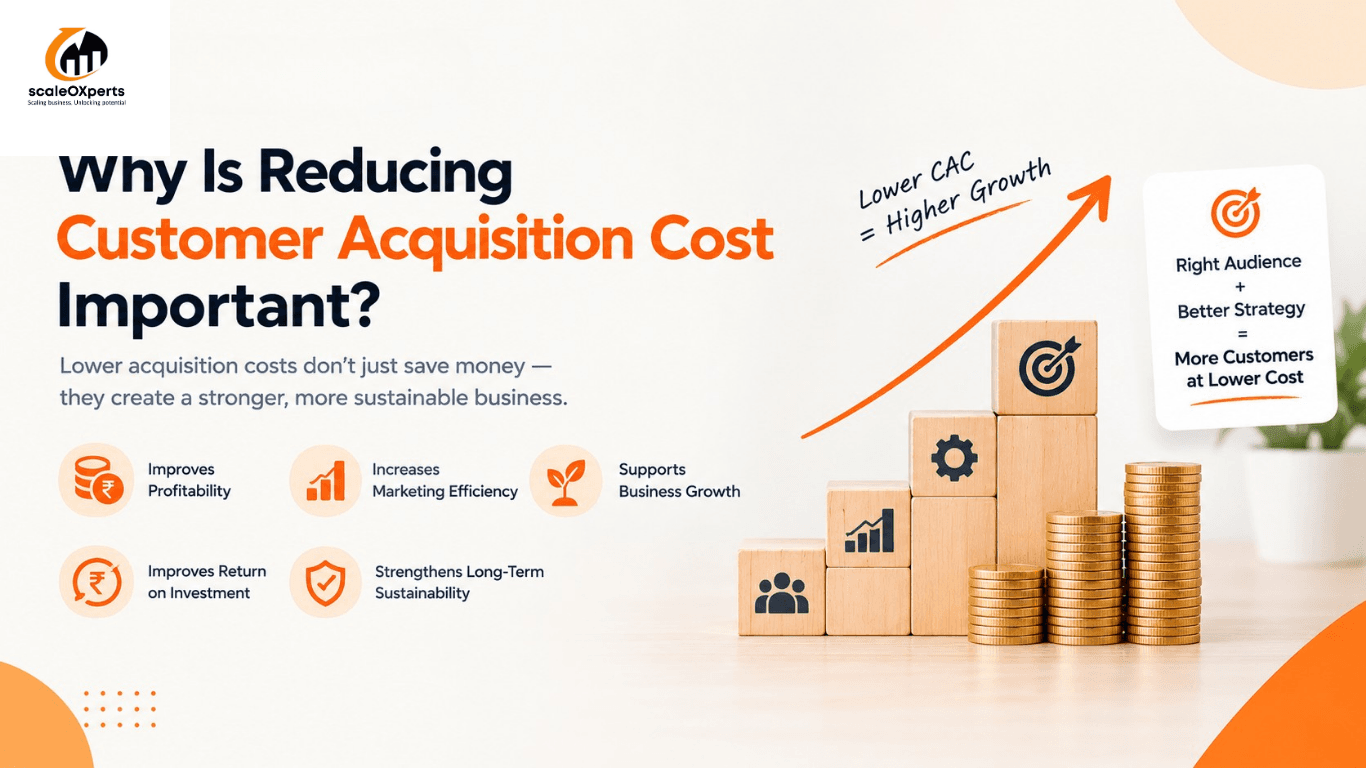
Reducing CAC can:
• Improve profitability: Lower acquisition expenses can leave more revenue available to cover operating costs and profit.
• Increase marketing efficiency: Businesses can identify underperforming campaigns and shift resources to channels that deliver better results.
• Support scalable growth: Efficient acquisition makes it easier to expand campaigns without increasing costs at the same rate.
• Improve return on investment: Better budget allocation can improve the value generated by marketing activities.
• Support long-term sustainability: A balanced acquisition strategy helps businesses grow while protecting profit margins.
The goal is not simply to spend less. It is to attract suitable customers through channels that deliver measurable results at a sustainable cost.
1. Focus on Search Engine Optimization (SEO)
Search engine optimization (SEO) can help reduce customer acquisition costs over time by making a website more visible in organic search results. Unlike paid advertising, organic listings do not charge for every click. However, SEO still requires investment in content, technical improvements, and ongoing optimization.
To improve SEO performance:
• Research relevant keywords to understand what potential customers search for.
• Optimize website pages with primary and secondary keywords naturally.
• Publish useful blog posts that answer customer questions.
• Improve website speed, mobile usability, and technical SEO.
• Earn relevant backlinks from credible websites.
• Optimize service pages for commercial and transactional search intent.
• Use internal links to connect informative content with relevant service pages.
For example, a coaching institute could create pages targeting phrases such as "IELTS coaching classes," "SAT preparation course," or "coaching institute near me," depending on its location and courses. Helpful course pages and articles can attract students who are actively comparing options.
A D2C brand could publish buying guides and product comparison content that answers questions customers ask before purchasing. When these pages rank for relevant searches, the brand may attract potential buyers without paying for each visit.
Businesses can explore ScaleOXperts' digital marketing services to understand how SEO can support visibility, lead generation, and business growth.
SEO usually takes time to deliver results, but well-maintained content can continue attracting relevant visitors after publication and reduce reliance on paid traffic.
2. Target the Right Audience With Paid Advertising
Google Ads and Meta Ads can generate leads and sales quickly, but poorly targeted campaigns can consume budgets without producing valuable business outcomes. Effective performance marketing focuses on reaching likely buyers and measuring results beyond clicks and impressions.
To improve paid campaign efficiency:
• Use high-intent keywords in Google Search campaigns.
• Add negative keywords to reduce irrelevant clicks.
• Separate campaigns by service, product, location, or audience.
• Test ad headlines, descriptions, creative formats, and calls to action.
• Track qualified leads, purchases, and conversion rates---not just clicks.
• Review search terms and pause or adjust campaigns that consistently attract low-quality leads.
• Set up conversion tracking before scaling spend.
For example, a coaching institute promoting IELTS classes could target people searching for IELTS coaching in its service area rather than using broad terms such as "English." Ads can direct users to a dedicated IELTS landing page with course details, schedules, location, and an enquiry form.
A D2C skincare brand could target relevant audiences with product-specific campaigns and send users to the matching product page instead of a generic homepage. It should assess purchases and profit---not just add-to-cart activity---when deciding which campaigns to scale.
The principle is simple: do not just pay for traffic. Invest in reaching people who are more likely to become customers.
A structured digital marketing and performance-focused strategy from ScaleOXperts can help businesses connect campaign activity with measurable outcomes.
3. Improve Website Conversion Rates
Generating traffic is only one part of successful digital marketing. If visitors leave without enquiring, booking, or purchasing, customer acquisition costs can remain high.
Conversion rate optimization (CRO) focuses on turning a higher proportion of existing website visitors into leads or customers. Improving conversion rates can produce more outcomes from the traffic a business already receives.
For example, suppose a website attracts 2,000 visitors each month and generates 40 enquiries. Its conversion rate is 2%. If website improvements increase that rate to 3%, the same traffic could generate 60 enquiries---a 50% increase in enquiries without increasing traffic.
To improve website conversions:
• Write clear, benefit-focused headlines.
• Add prominent calls to action, such as "Book a Free Consultation" or "Shop Now."
• Keep enquiry and checkout forms simple.
• Display genuine testimonials, reviews, and case studies.
• Ensure the website works smoothly on mobile devices.
• Improve page speed and navigation.
• Match landing page content to the ad or search query.
• Test page layouts, offers, forms, and calls to action.
For a coaching institute, a clear course page with fees or fee guidance, course duration, class format, location, and a visible enquiry button can help prospective students take the next step.
For a D2C brand, clear product images, delivery information, return policies, reviews, and a straightforward checkout can reduce uncertainty and abandoned purchases.
Businesses can also review ScaleOXperts' website development services when website usability, performance, or landing-page experience needs improvement.
4. Use Content Marketing to Attract Qualified Leads
Content marketing helps businesses answer customer questions, build trust, and attract relevant visitors. Instead of relying only on promotional messages, businesses can publish information that helps their audiences make decisions.
Useful content formats include:
• Educational blog posts and detailed guides.
• Case studies that explain outcomes and lessons.
• Industry reports and original research.
• Frequently asked questions.
• Educational videos and social media posts.
• Downloadable checklists and practical resources.
For example, a coaching institute could publish an article such as "How to Prepare for the IELTS Speaking Test" and link it to its IELTS course page. Readers who need structured preparation can explore the course or submit an enquiry.
A D2C nutrition or personal-care brand could create a product-selection guide that explains relevant features and helps shoppers choose between products. The guide can link to suitable product pages without making unsupported claims.
Content should address real audience needs, include relevant SEO keywords naturally, and link to service or product pages where useful. Avoid repeating keywords unnaturally; readability and usefulness should come first.
Content marketing may take time to build organic visibility, but strong resources can continue attracting potential customers and supporting conversions over the long term.
5. Use Email Marketing to Nurture Leads
Not every prospect is ready to buy immediately. People often need time to compare options, understand a service, or decide whether a product suits their needs. Email marketing helps businesses follow up with people who have voluntarily subscribed or enquired, without paying for a new ad click every time.
Businesses can improve email campaign performance by:
• Segmenting subscribers by interests, behaviour, or stage in the buying journey.
• Sending relevant messages that match their needs and consent.
• Sharing helpful information rather than sending only sales promotions.
• Creating welcome and follow-up sequences.
• Sending reminders to prospects who have shown interest, where appropriate.
• Testing subject lines, email content, and calls to action.
For example, someone who enquires about an IELTS course could receive follow-up emails with course details, preparation tips, schedules, and instructions for booking a counselling call.
A D2C brand could send product-care tips after a purchase or, with appropriate consent and platform setup, a reminder to a shopper who left items in their cart. Messages should be useful, respectful, and compliant with applicable privacy requirements.
Email marketing is especially valuable when customers need time to make a decision. It can help businesses nurture existing leads instead of repeatedly paying to reach new audiences.
6. Leverage Social Media Marketing Strategically
Social media gives businesses opportunities to build awareness, share useful information, answer questions, and develop relationships with potential customers. However, posting on every platform does not automatically reduce customer acquisition costs. Businesses should focus on channels used by their target audiences.
For example, a coaching institute could share student-approved testimonials, course explainers, exam-preparation tips, and answers to common questions on the platforms its prospective students use. A D2C brand could demonstrate how its products work, share customer reviews, and publish product-focused videos.
To make social media marketing more cost-effective:
• Choose platforms based on audience behaviour.
• Publish useful, relevant, and engaging content.
• Respond promptly to comments and messages.
• Share genuine customer experiences with permission.
• Use short videos to explain products or services.
• Track website visits, qualified enquiries, and purchases.
• Retarget interested users where appropriate and permitted.
Organic social media can build awareness and trust over time, while well-targeted paid campaigns can reach specific audiences. Connect social activity to measurable business objectives instead of focusing only on followers, likes, and impressions.
7. Retarget Interested Website Visitors
Many website visitors leave without enquiring or buying during their first visit. They may be comparing alternatives, checking prices, or simply not ready to decide.
Retargeting allows businesses to reach eligible previous visitors with relevant ads, subject to platform rules, consent requirements, and privacy laws.
For example, a visitor who views a coaching institute's course page but does not enquire could later see an ad highlighting course features or inviting them to book a counselling session.
A D2C shopper who views a product page could see a relevant reminder or product demonstration. The message should reflect the shopper's interest rather than repeatedly showing the same generic advertisement.
Retargeting can help businesses:
• Re-engage people who have already shown interest.
• Build familiarity while prospects compare options.
• Share relevant offers or additional product information.
• Encourage visitors to complete an enquiry or purchase.
To keep retargeting efficient, create audience segments based on meaningful actions, exclude customers who have already converted when appropriate, limit repetitive ad exposure, and measure how many new customers the campaigns actually generate.
Retargeting works best as part of a wider digital marketing strategy---not as a replacement for strong targeting, useful landing pages, and conversion tracking.
8. Track Marketing Performance and Optimize Campaigns
Customer acquisition costs can rise when businesses continue spending on campaigns without understanding which channels generate paying customers.
Use tools such as Google Analytics 4, Google Search Console, advertising platform reports, and a customer relationship management (CRM) system to evaluate performance. Make sure conversion events are configured correctly and, where possible, connect lead records with sales outcomes.
Important metrics include:
• Customer acquisition cost (CAC): The average cost of acquiring a new customer.
• Cost per lead (CPL): The amount spent to generate a lead.
• Conversion rate: The percentage of visitors or leads who complete a desired action.
• Click-through rate (CTR): The percentage of impressions that result in clicks.
• Return on ad spend (ROAS): Revenue attributed to advertising relative to advertising spend.
• Customer lifetime value (CLV): The estimated value a customer generates over the relationship with a business.
Review these metrics regularly. Cheap leads are not necessarily valuable if they rarely become customers. If lead quality is poor, refine targeting, improve landing-page content, and review how quickly the sales team follows up instead of simply lowering bids.
Include relevant marketing and sales expenses in CAC calculations, and compare acquisition costs with customer value and profit margins. Use consistent definitions and time periods when comparing channels.
9. Align Marketing and Sales Teams
Digital marketing can generate enquiries, but the sales process influences how many of those enquiries become customers. Slow responses, missed calls, inconsistent follow-ups, and poor lead tracking can waste marketing spend.
Marketing and sales teams should agree on what qualifies as a lead, how quickly enquiries should receive a response, and how lead quality and outcomes will be recorded.
Useful steps include:
• Define the ideal customer profile.
• Agree on the difference between marketing-qualified leads and sales-qualified leads.
• Respond to enquiries promptly.
• Use a CRM to track interactions and sales outcomes.
• Identify which marketing channels generate actual customers.
• Review lost opportunities to understand why prospects did not convert.
For example, a coaching institute can track whether enquiries from a particular course campaign turn into counselling appointments and enrolments. A D2C brand can compare campaign sources with completed purchases and repeat orders.
When lead handling improves, businesses may be able to generate more customers from the leads they already receive---helping reduce the effective cost of acquisition.
Frequently Asked Questions About Customer Acquisition Cost
1. What is a good customer acquisition cost?
There is no universal ideal CAC. It depends on your industry, selling price, profit margin, repeat-purchase rate, and customer lifetime value. A sustainable CAC allows the business to acquire customers while still covering its other costs and generating profit.
2. How can a business reduce customer acquisition cost?
Businesses can improve SEO, refine paid advertising, optimize landing pages, nurture leads through email, use social media strategically, retarget interested visitors, and improve sales follow-up. Track which actions produce paying customers rather than judging performance only by clicks or leads.
3. Does SEO reduce CAC?
SEO can reduce reliance on paid clicks by attracting relevant visitors through organic search. However, SEO involves costs for content, technical improvements, and ongoing work, and results usually take time. Measure the cost of SEO against the qualified leads and customers it generates.
4. How can D2C brands lower customer acquisition costs?
D2C brands can improve product-page content and checkout usability, target high-intent audiences, use customer reviews and helpful product content, test creative and offers, and encourage repeat purchases through relevant customer communication. Evaluate acquisition cost alongside contribution margin and repeat-purchase value.
5. What is the difference between cost per lead and customer acquisition cost?
Cost per lead (CPL) measures how much it costs to generate a lead or enquiry. CAC measures how much it costs to acquire a paying customer. A campaign may generate inexpensive leads but still have a high CAC if few leads convert into customers.
6. How often should CAC be reviewed?
Review CAC regularly---often monthly, with more frequent monitoring for active paid campaigns. Consider sales-cycle length and conversion delays before making decisions, and compare like-for-like periods so that short-term fluctuations do not lead to premature changes.
Conclusion
Reducing customer acquisition cost requires strategic planning, accurate measurement, and ongoing optimization. Digital marketing helps businesses reach suitable audiences, attract qualified leads, improve website performance, and allocate budgets to the channels that contribute to profitable growth.
SEO, performance marketing, paid advertising, social media, retargeting, conversion rate optimization, and sales alignment work best when they support the same business goals. Identify your target customers, track the journey from first interaction to sale, and invest in the channels that deliver sustainable customer value---not just website traffic or social engagement.
Whether you run a coaching institute looking to increase enrolments or a D2C brand aiming to generate profitable online sales, the right strategy should be based on your audience, margins, and conversion data.
Ready to acquire customers more efficiently? Book a Free Growth Audit with ScaleOXperts.
Explore our digital marketing services and website development services to see how a stronger digital strategy and website experience can support your growth.