
Here's Why Customers are (Or Aren't) Finding You Differently
The number of people who come to your website from Google might not be that big, but the visitors you attract seem like they already know what you are offering before they even get to your website. Perhaps a message arrives on WhatsApp, posing a question that looks as if it could have been lifted directly from your website's frequently asked questions (FAQs).
It's not an accident. AI-powered search is what you're seeing; this isn't some far-off, emerging idea; small businesses will have to deal with it. This evolution might not grab the same sensational headlines as discussions of AI-powered job displacement or future robotic overlords, but its impact on the local bakery down the street, your neighborhood training academy, or even a B2B manufacturer could be more significant than any of it. The nature of search — in essence, the entry point for nearly every small business — has been reshaped.
From "10 Blue Links" to "One AI Answer"
For two decades, small business SEO had a simple logic: rank on page one, get the click, convert the visitor. That logic still exists, but it now shares the stage with something new — AI Overviews, chatbot answers, and AI shopping assistants that summarize information before a user ever reaches a website.
Industry tracking in early 2026 shows AI Overviews appearing in roughly half of all tracked search queries, nearly double the share from a year earlier, though the exact number swings wildly by industry — informational and "how to" queries get AI summaries constantly, while local service searches (plumbers, electricians, tutors) still lean heavily on the traditional Map Pack. For a small business, this means the game isn't over, but it's being played on two boards at once: the classic organic results, and a new AI-generated answer sitting above them.
The practical effect is what marketers call "zero-click" search — a person gets their answer without visiting any website at all. That's unsettling if your business has spent years optimizing purely for traffic. But it's also an opportunity, because being the source an AI system cites or recommends is quickly becoming as valuable as the click itself — sometimes more so, because that AI-referred customer tends to arrive already convinced.
The Surprising Twist: AI Traffic Converts Better
Here's the part that should genuinely change how small businesses think about this. A year or so ago, the early data on AI-referred shoppers was discouraging — traffic from AI tools was converting noticeably worse than regular search traffic. People assumed this meant AI search was just noise: lots of curious browsing, not much buying.
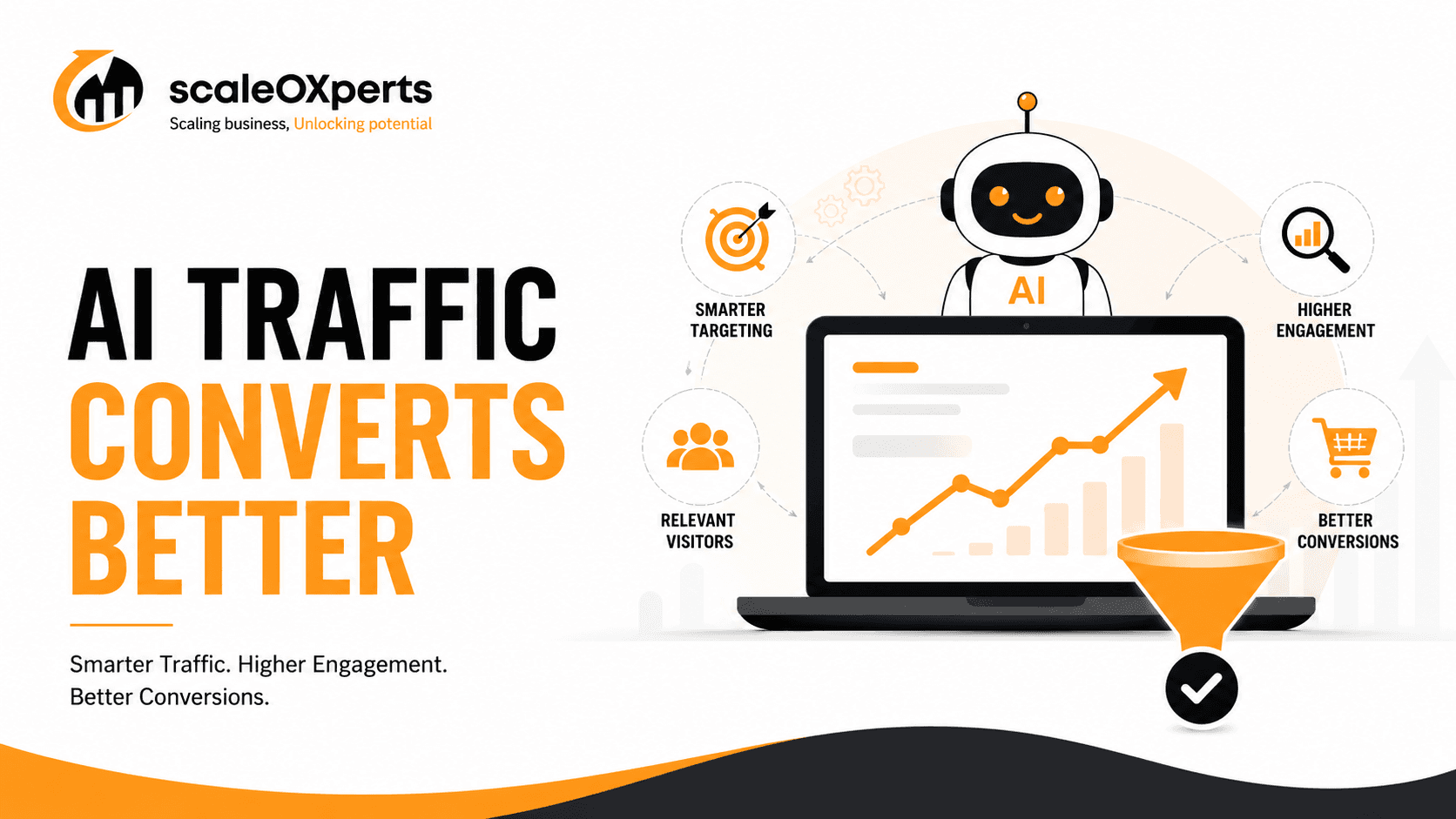
That story has flipped. Recent retail analytics show AI-referred shoppers now converting meaningfully better than traditional organic visitors, and the volume of that traffic has exploded — growth in the thousands of percent year-over-year during peak shopping periods. The explanation makes intuitive sense: when someone asks an AI assistant to compare products or recommend a service, the assistant has essentially done their research for them. By the time they click through, they're not window-shopping — they're ready to decide.
For small businesses, this is the real headline of 2026: AI search isn't just changing how people find you, it's changing who shows up at your (digital) door. The visitors are fewer in number, but more qualified.
Who's Actually Adopting AI — and Why It's Not Just the Big Guys
There's a persistent myth that AI adoption is a big-company game, with small businesses stuck watching from the sidelines. The data tells a different story. Multiple 2026 surveys put regular AI use among small businesses somewhere between 58% and 68%, up sharply from well under half just two years ago. Some research even suggests the smallest businesses — solo operators and micro-teams — are adopting AI tools faster than mid-sized companies, essentially using AI as a stand-in for the employees they can't yet afford to hire.
What are they actually using it for? Overwhelmingly: marketing content, customer service, and everyday admin. Drafting social captions, answering routine customer questions, summarizing notes, doing quick research. It's not glamorous, but it's exactly the kind of grinding, repetitive work that used to eat up a small business owner's evenings.
This is also where a lot of businesses get stuck — they know AI matters but don't know where to start turning it into an actual workflow. That's the gap Scaleoxperts, a growth strategy firm exists to close: helping small and mid-sized businesses move past ad-hoc chatbot use and build AI and AEO practices into how they actually market and operate, rather than treating it as a side experiment.
And the reported payoff is real. The majority of small businesses using AI say it has improved efficiency, and a notable share report direct revenue gains. That said, there's an honest caveat worth sitting with: a lot of this adoption is still shallow. Plenty of businesses are dabbling with a free chatbot for the occasional email rather than building AI meaningfully into how they operate. The gap that matters in 2026 isn't small versus large business anymore — it's businesses treating AI as a novelty toy versus businesses embedding it into actual workflows.
What This Means If You Depend on Local or Niche Search
If your business lives or dies by local search — a clinic, a coaching institute, a repair shop — the picture is more reassuring than the broader AI narrative suggests. AI Overviews have crept into local service searches too, but the Map Pack and traditional local listings still drive the overwhelming majority of leads for hands-on, location-based services. People still want to see reviews, hours, and a map pin when they need someone now.
But there's a catch: AI systems increasingly pull from the same structured data — business listings, citations, review platforms — to decide what to recommend inside a chat answer. So the unglamorous SEO fundamentals (consistent NAP data, strong reviews, clean directory listings) haven't become obsolete. If anything, they've become the raw material AI assistants trust when deciding who to mention by name.
What Small Businesses Should Actually Do About It
None of this calls for panic or a total strategy overhaul. It calls for a few deliberate shifts:
Write for the answer, not just the click. Structure content so an AI system can lift a clean, accurate summary from it — clear headings, direct answers near the top, FAQ-style sections. If an AI is going to summarize your expertise anyway, make sure it's summarizing the right version of it.
Keep your structured data current. Business details, service listings, pricing, and reviews across every platform should say the same thing everywhere. AI systems cross-reference this to decide who's trustworthy enough to recommend.
Don't abandon the human voice. Ironically, as more content becomes AI-generated, genuine human perspective — real case studies, real testimonials, a real person's opinion — stands out more, not less. Trust is becoming the differentiator that pure content volume used to be.
Treat AI tools as a lean team member, not a gimmick. The businesses seeing real returns aren't the ones dabbling occasionally; they're the ones that picked one workflow — content drafting, customer replies, lead research — and actually built it into daily operations.
Watch conversion, not just traffic. If your overall visitor numbers dip but AI-referred visitors are converting well, that's not a red flag. That's the market maturing.
The Bottom Line
AI-powered search hasn't replaced the small business playbook in 2026 — it's added a second layer to it. The businesses adapting well aren't necessarily the most technical ones; they're the ones paying attention to where their customers are actually forming opinions now, whether that's a Google AI Overview, a ChatGPT recommendation, or a locally sourced review. The fundamentals of being clear, credible, and easy to find haven't gone away. They've just picked up a new audience: the algorithms doing the recommending on your customers' behalf.
If you're not sure where your business currently stands with AI-powered search, Scaleoxperts — a growth strategy firm providing digital marketing services and strategic growth consulting — offers AEO and AI-search audits to help small businesses figure out exactly that, and where the highest-leverage first move actually is.
Frequently Asked Questions
1. What is AI-powered search? AI-powered search uses artificial intelligence to provide direct, conversational answers instead of only displaying a list of web pages. Platforms like ChatGPT, Google AI Overviews, Perplexity, and Gemini summarize information from multiple trusted sources to answer user queries quickly.
2. How is AI-powered search different from traditional search engines? Traditional search engines primarily rank websites based on keywords and backlinks. AI-powered search focuses on understanding user intent and delivering complete, relevant answers, often without requiring users to click multiple links.
3. Why should small businesses care about AI-powered search? AI-powered search is changing how customers discover businesses online. Companies that optimize their websites for AI search can increase visibility, build trust, and attract high-quality leads, even if they aren't ranking #1 on Google.
4. Will SEO still be important in 2026? Absolutely. SEO remains essential, but it has evolved. Businesses now need to combine traditional SEO with AI Optimization (AEO) and Generative Engine Optimization (GEO) to improve visibility across AI-driven platforms.
5. What is AEO (Answer Engine Optimization)? AEO focuses on structuring content so AI assistants and search engines can easily understand and present it as direct answers. This includes using FAQs, schema markup, concise explanations, and clear content formatting.
6. Who can help my business adapt to AI-powered search? A growth strategy firm offering digital marketing services— such as Scaleoxperts — can audit your current visibility, clean up your structured data, and help build AI-ready content workflows tailored to your business.